Drawn in Salt: The Secret Maps Surfers Use to Guard Their Favorite Breaks
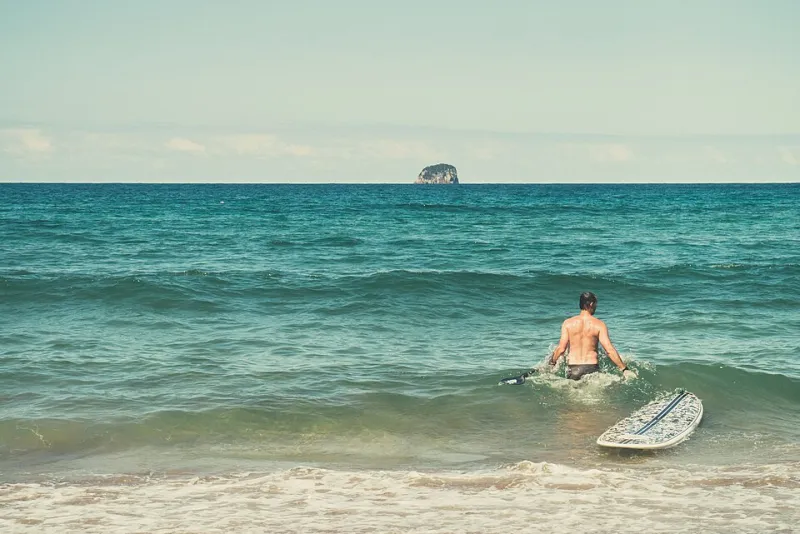
Photo: Jens Theeß jenstheess, CC0, via Wikimedia Commons
Somewhere in a garage in Santa Cruz, there's a folded piece of notebook paper with coffee stains on one corner and a faded pencil sketch on the other. It shows a coastline, a few landmarks, and a break that maybe a dozen people know by name. The guy who drew it is in his sixties now. He got it from someone older. And he's only passed it on twice.
That's how a lot of surf knowledge actually moves—not through apps or algorithms, but through trust, timing, and a whole lot of patience.
The Original Offline Network
Before anyone had a smartphone, surfers were building their own intelligence networks. Older locals would drop hints at the right moment—a comment about tide windows, a vague reference to a road that "goes somewhere interesting" if you follow it long enough. For generations, this was the primary way hidden breaks stayed hidden. You earned the information by showing up, keeping your mouth shut, and proving you weren't the type to blow up a spot.
Mike Delgado, who's been surfing the Northern California coast for over thirty years, still keeps a hand-drawn chart of his favorite lesser-known spots tucked in his van. "My uncle gave me a version of that map when I was seventeen," he says. "I've updated it over the years, added notes about swells, marked where the rocks are at low tide. It's not something I'd ever post online. That's not the point of it."
The point, he explains, is the relationship embedded in the information. When you give someone a map like that, you're extending a kind of trust that comes with expectations attached. Show up, be respectful, don't bring a crowd.
Going Digital Without Going Public
Of course, the internet changed things—just not always in the ways you'd expect. While platforms like Instagram have definitely blown up more than a few once-quiet breaks, a parallel underground has emerged online that functions almost exactly like those old paper maps. Private Facebook groups, invite-only Discord servers, encrypted message threads—dedicated surfers have found ways to use digital tools while keeping the information tightly gated.
Jordan Reyes, a web developer and lifelong surfer based in San Diego, moderates one such group for Southern California locals. It has a few hundred members, but getting in isn't easy. "You need a referral from someone already in the group," she explains. "And there's a vetting period. We look at whether you're actually a surfer, whether you seem to understand local culture, whether you've got any history of dropping spot names publicly."
The group shares swell reports, session photos with location details cropped out, and occasionally—very occasionally—specific directions to breaks that don't show up on any public surf map. "We've had to kick people out for screenshotting stuff and sharing it," Reyes says. "When that happens, the trust breaks down and everyone loses access to the good stuff. It self-regulates pretty naturally."
The Ethics of Discovery
Not everyone agrees that keeping breaks secret is a noble pursuit. Critics argue that gatekeeping access to public coastlines has an exclusionary edge—that the unwritten rules of surf localism can slide pretty quickly from "protecting a resource" into "protecting our turf from people who don't look like us." It's a fair tension, and it's one the surf community is actively wrestling with.
"There's a difference between protecting a break from being overrun and using secrecy as a way to keep certain people out," says Tamara Hughes, a surf instructor and community organizer who works with beginner programs along the Gulf Coast. "The ocean belongs to everyone. But at the same time, I get it—some of these places are genuinely fragile, and too much traffic can wreck the ecosystem and the vibe."
Hughes has started developing what she calls "graduated access" programs for her students—teaching them the ethics of spot discovery before they ever get pointed toward anything off the beaten path. That means learning to read a lineup, understanding right-of-way, and spending time at more established breaks before anyone mentions the quieter ones.
"We talk about it like an apprenticeship," she says. "You don't get the keys to the back room on day one. You earn them by showing you belong there."
Cartographers of the Coast
A small but growing group of surfers has taken a more systematic approach to documenting breaks—not to share them publicly, but to preserve the knowledge for their own communities. Think of them as surf cartographers: people who combine old-school observation with modern mapping tools to create detailed records of breaks that might otherwise exist only in the memories of a few aging locals.
These aren't the kind of maps you'd find on a surf forecast site. They include notes on seasonal sand shifts, observations about how certain swells interact with underwater topography, and warnings about hazards that don't show up anywhere official. Some are kept as private documents shared only within tight-knit crews. Others exist as handwritten journals passed between mentors and mentees.
Delgado has started digitizing some of his notes, though he's careful about how he stores them. "I'm not putting this on Google Drive," he laughs. "But I want to make sure the information doesn't die with me. There are breaks I know that nobody else does anymore. That feels like a loss if it just disappears."
What the New Surfer Owes the Old Wave
For newer surfers trying to find their footing—literally and figuratively—navigating this culture can feel intimidating. The unspoken rules aren't written anywhere obvious, and the consequences of getting them wrong can range from cold shoulders to full-on confrontation.
But most experienced surfers will tell you the path forward is pretty simple: start at the crowded spots, be humble, ask questions respectfully, and give it time. The information finds people who've proven they can handle it.
"I waited three years before anyone told me about the spot I surf most now," says Reyes. "Three years of showing up at the same beach, paddling out in conditions most people wouldn't bother with, just being a consistent presence. And then one morning, this guy I'd seen around forever paddles over and goes, 'Hey, you ever surf out by the point?' That was it. That was the whole invitation."
There's something genuinely beautiful about that—a culture that still runs, at its core, on patience and presence rather than clicks and followers. The best breaks aren't always the ones you find on a map. Sometimes they're the ones you earn the right to know about.
And somewhere, in a van or a drawer or a tucked-away folder on a hard drive no one else can access, someone's keeping that knowledge safe until the right person comes along.