Peaks, Priority, and Patience: Learning to Read the Social Code of Any Surf Lineup
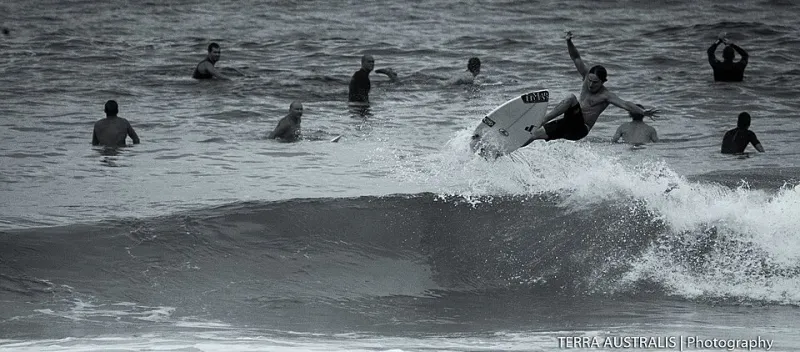
Photo: Bj Murphy, CC BY 3.0, via Wikimedia Commons
Pull into any parking lot at a busy break on a Saturday morning and you'll immediately notice something: the ocean looks chaotic, but it isn't. Watch long enough and you'll start to see structure. There's a rhythm to who paddles where, who sits deepest, who lets someone else go. It's a social system built without a single posted sign, enforced without a referee, and passed down mostly through observation and the occasional blunt word from a stranger.
This is lineup culture. And if you don't understand it, the water is going to feel a lot less welcoming than it should.
The Wave Belongs to the Person Closest to the Peak
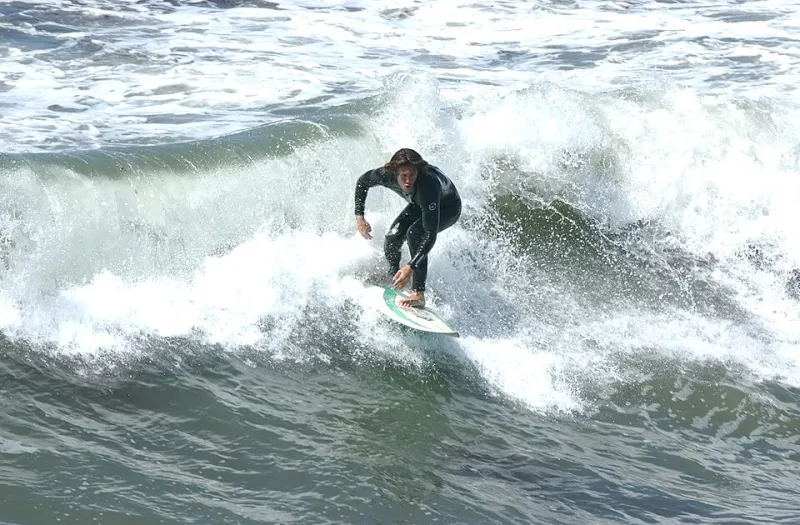
Let's start with the most fundamental rule, the one that every other piece of etiquette flows from: the surfer closest to the breaking part of the wave — the peak — has priority. That's it. That's the whole foundation.
But of course, it's never quite that simple.
"People think they know the right-of-way rule, and then they paddle into a crowded break and completely forget it the second a set rolls in," says Marcus Delgado, a 54-year-old surfer who's been riding his home break in San Diego County for over three decades. "Your brain goes into wave-hunger mode and suddenly every rule you know disappears."
The drop-in — paddling into and riding a wave that someone else already has priority on — is the cardinal sin of surfing. It's dangerous, it's disrespectful, and it's the fastest way to make enemies in the water. But Delgado is quick to point out that most drop-ins aren't malicious. "Ninety percent of the time, it's someone who just didn't see the other surfer. Doesn't make it okay, but understanding that changes how you respond to it."
Locals, Visitors, and the Hierarchy Nobody Talks About Out Loud
Here's where it gets more complicated. Priority based on wave position is the written rule. But there's an older, unspoken layer underneath it — one built on consistency, familiarity, and time logged at a particular break.
Locals earn a kind of informal seniority. Not because they deserve waves more than anyone else, but because they've put in the hours, they know the break's quirks, and — whether fair or not — they've claimed a relationship with that stretch of water. Walk into their lineup without acknowledging that, and you're going to have a rough session.
"I don't think it's about entitlement," says Priya Nair, a surf instructor based out of the Outer Banks who works with adult beginners. "It's more like... you're a guest at someone's house. You don't walk in and immediately put your feet on the furniture. You read the room first."
That metaphor resonates with a lot of experienced surfers. The lineup is a shared space, but it's not a blank slate. Showing up with humility — sitting a little wider at first, letting a few waves go, watching how the locals position themselves — communicates something important. It says you're paying attention.
The Generational Divide
Younger surfers, especially those who came up through wave pools or learned via YouTube tutorials, sometimes arrive at ocean breaks with a different relationship to these norms. And that's creating some friction.
"I had a kid drop in on me three times in one session," Delgado says, shaking his head. "Not mean about it, just... oblivious. When I finally said something, he looked genuinely confused. He'd never been told."
That gap — between those who absorbed lineup culture through years of in-water mentorship and those who learned to surf in more structured, controlled environments — is one of the defining tensions in American surf culture right now. Wave pools are incredible for progression, but they don't teach you how to share a peak with fifteen strangers who all want the same wave.
Nair sees it constantly in her teaching work. "I make lineup etiquette part of every single lesson, even if we're in waist-high whitewater. Because the habits you build early are the ones that stick. If you learn to look both ways before you go, you'll always look both ways."
Snaking, Sitting Wide, and Other Subtle Violations
Beyond the drop-in, there's a whole vocabulary of behavior that experienced surfers notice even when they don't call it out explicitly.
Snaking — repeatedly paddling around someone to steal their priority position — is sneaky and widely despised. It's technically legal since you end up closest to the peak, but everyone in the water knows what you're doing.
Hogging the peak — sitting at the best takeoff spot and catching every single wave without giving others a turn — is another one. In a crowded lineup, there's an unspoken expectation that you'll rotate, that you'll paddle back out wide after a ride and let someone else have the next one.
Paddling through the lineup carelessly, cutting through where people are riding, not calling out when you're paddling over a wave — these are the small stuff, but they add up.
"It's all about spatial awareness," says Jordan Reeves, a conflict resolution facilitator in Santa Cruz who occasionally works with surf schools and community beach programs. "Most lineup tension isn't really about waves. It's about people feeling unseen. When you acknowledge someone — make eye contact, give a nod, call out 'sorry' after a close call — it defuses almost everything."
How to Walk Into a New Break Without Making Enemies
So what's the move when you pull up to a break you've never surfed before? Reeves, Nair, and Delgado all landed on similar advice.
First, watch before you paddle out. Spend ten minutes on the beach understanding the peak, the crowd, and the general energy. Is it mellow? Competitive? Territorial? That intel is worth more than any guidebook.
Second, start conservative. Don't immediately paddle to the peak. Sit on the shoulder, take a few smaller waves, let people see that you can surf and that you're not there to blow up their session.
Third, talk to people. A simple "Hey, how's it been out here?" goes a long way. Surfers, even the crusty ones, generally appreciate someone who shows genuine interest in their break.
And finally — maybe most importantly — give waves away. Nothing builds goodwill faster than letting a good set wave go to someone who's been waiting longer. It signals that you're not just there to take.
The Bigger Picture
Lineup etiquette isn't just about avoiding conflict. It's about what kind of surf culture we're building, wave by wave, session by session. As surfing grows — and it is growing, with more people in the water than ever before — the pressure on breaks intensifies. The social code that holds it all together matters more, not less.
"The ocean is generous," Nair says. "There are always more waves. If we can remember that, most of the drama takes care of itself."
That's the thing about lineup culture. At its best, it's not about hierarchy or gatekeeping. It's about a shared understanding that allows a bunch of strangers to coexist in a small patch of ocean and all go home feeling like they got something out of it.
Read the room. Respect the peak. And when in doubt, let the wave go. There'll be another one.