First Paddle, Last Impression: How to Enter Any New Break Without Burning Your Welcome
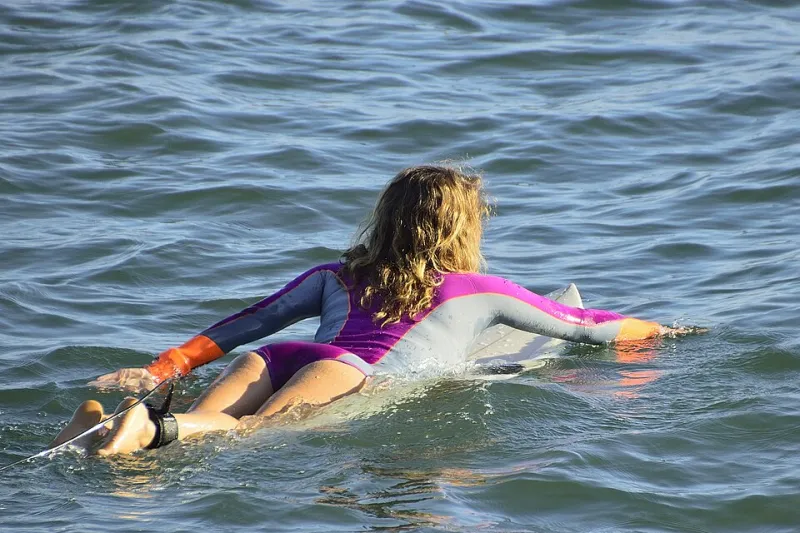
Photo: Mike van Dalen from Australia, CC BY 2.0, via Wikimedia Commons
There's a moment every surfer knows — you pull into a new parking lot, step out of the car, and just look. The waves are firing. The lineup is packed. And somewhere between excitement and anxiety, you realize you don't know a single face out there.
What happens next matters more than most people admit.
Paddling out at an unfamiliar break isn't just a physical act. It's a social one. Every surf community — whether it's a mellow beach break in the Outer Banks or a heavy reef point on the North Shore of Oahu — has its own rhythm, its own hierarchy, and its own tolerance for strangers. The difference between being welcomed and being frozen out often comes down to the first five minutes in the water. Here's how to make them count.
Read the Beach Before You Ever Touch the Water
The shore is your best intelligence source, and most surfers don't use it nearly enough.
Before you wax up, spend a solid ten to fifteen minutes just watching. Not scrolling your phone, not chatting with your buddy — actually watching. Who's getting the best waves? Where are the regulars sitting? Is there a defined peak, or does the crowd spread out along a long, shifty break? Are people sharing sets generously, or does one crew seem to be quietly controlling the lineup?
These observations aren't just interesting — they're a map. They tell you where you probably shouldn't park yourself on your first session, who the informal authority figures are, and whether the vibe is relaxed or territorial. A beach break in Santa Cruz is going to operate very differently from a pier break in Huntington or a jetty spot in New Jersey. Every break has its own culture, and the fastest way to respect it is to understand it before you enter.
Also worth noting: if there's a surf shop nearby, stop in. Seriously. A two-minute conversation with someone behind the counter can save you from a week's worth of awkward sessions. Ask about the break, the crowd, any local customs. Most surf shop folks are happy to talk, and showing that kind of respect signals that you're not just another tourist blowing through.
The Channel Is Your Best Friend
When it's finally time to paddle out, your route matters.
One of the fastest ways to irritate an established lineup is to paddle straight through the impact zone during a set, bumping boards, disrupting surfers on waves, and generally creating chaos. Even if it's unintentional, it reads as careless. At a new break, careless is the last thing you want to look.
Find the channel — the calmer, deeper water that runs alongside or around the breaking waves — and use it. If there isn't an obvious channel, time your paddle to avoid sets, and if a wave is about to break near you while someone is riding it, kick off your board and dive under rather than hesitating in the path of a moving surfer. The golden rule here is simple: the person on the wave has the right of way, always. Your job is to get out of theirs.
This applies even when it's inconvenient. Even when a wave is about to hit you square in the face. A little wipeout on your part is far better than a collision that ruins someone else's ride — and your reputation.
Sit on the Shoulder First. Earn Your Way to the Peak.
You made it out. Now comes the part that most intermediate surfers get wrong.
Don't paddle straight to the peak.
I know. The peak is where the best waves are. That's why everyone is sitting there. But when you're the new face in the water, walking up and planting yourself in the most coveted spot in the lineup is the surfing equivalent of cutting to the front of a line you just discovered. Even if you're technically allowed to be there, it creates friction.
Instead, start on the shoulder or the inside. Catch a few smaller waves. Let people see that you can actually surf — that you're not going to drop in on someone, that you understand right-of-way, that you're not a liability. This isn't about being submissive. It's about being smart. Once the regulars see that you know what you're doing and that you're not trying to snake anyone's waves, the invisible wall usually starts to come down on its own.
Some breaks are faster about this than others. At a mellow beach break in Florida, you might feel comfortable after a wave or two. At a more localized spot in California or Hawaii, it might take multiple sessions before you feel genuinely welcomed at the peak. That's not an insult — that's just how tight-knit surf communities protect what they love.
The Nod, the Smile, and the Simple Hello
Here's something nobody talks about enough: basic human decency goes a long way in the water.
A nod to the person next to you. A "nice one" when someone pulls into a good barrel. Letting a wave go when there's genuine ambiguity about who had priority. These tiny gestures cost you nothing, and they communicate something important — that you're here to be part of the community, not to take from it.
Conversely, the things that get people blacklisted fast are pretty predictable. Dropping in on established locals. Paddling around someone who was clearly in position first. Snaking waves repeatedly. Loudly complaining about the conditions or the crowd. Showing up with five of your friends and immediately dominating the peak like you own the place. Any one of these can brand you as someone the lineup doesn't want around.
And yes, people remember. Surf communities are small and long-memoried. The guy who burned someone in 2019 is still the guy who burned someone in 2019.
When the Vibe Goes Cold
Sometimes, despite your best efforts, a break just isn't going to receive you warmly. It happens. Some spots have a reputation for localism that's genuinely unwelcoming to outsiders, and no amount of shoulder-sitting or friendly nods is going to change that in a single session.
Know when to read that signal and respect it. You don't have to fight for a place in every lineup. There are plenty of breaks in this country that welcome traveling surfers with open arms — and honestly, those are often the more fun sessions anyway. Finding the right community fit matters as much as finding the right wave.
But in most cases, patience and humility are enough. Show up. Be respectful. Surf well. Come back a few times. The water has a way of sorting things out.
Because at the end of the day, every surfer you see in that lineup was once a stranger to it too. They earned their spot through time and respect. All they're asking is that you do the same.