When the Swell Speaks: How America's Coastal Rhythms Are Shaping a New Wave of Original Music
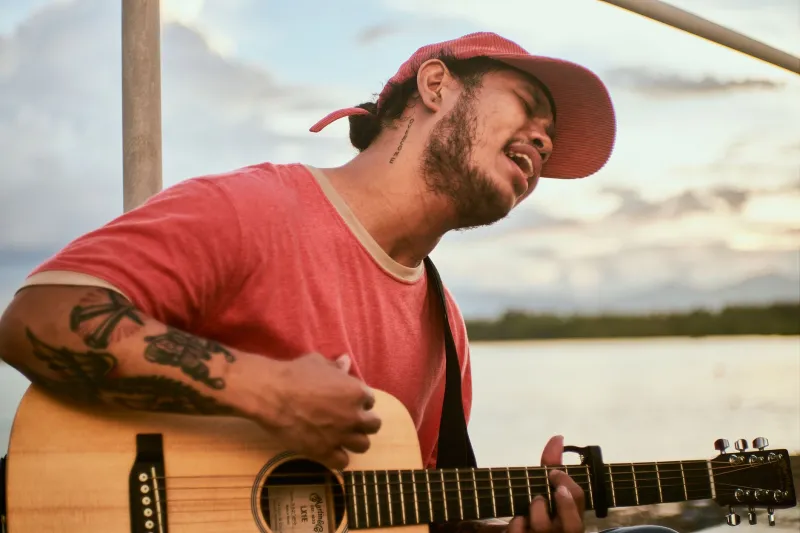
There's a moment every surfer knows — that pause before a set arrives, when the ocean goes quiet and the horizon stacks up in dark lines. For most people in the water, it's anticipation. For Marcus Delray, a guitarist and regular at a reef break outside of Santa Cruz, it's a time signature.
"I started humming stuff out there," Delray says, laughing a little at how strange that sounds. "Not on purpose. The interval between waves just gets into your head. You're counting. You're waiting. And when I got home, I'd pick up the guitar and whatever came out had that same kind of breathing in it."
Delray is one of a loose, largely unorganized generation of musicians who've found their creative compass not in a studio, but in a lineup. Across the US — from the Pacific Northwest down through Baja, across to the Florida Panhandle and up the Atlantic seaboard — surfers who also happen to make music are producing original work that's directly shaped by where they surf and when.
This isn't a genre. There's no label for it yet, and most of the people doing it would probably resist one anyway. But the pattern is real, and it's worth paying attention to.
The Seasonal Lens
Ask any experienced surfer about their local break and they'll describe it differently depending on the time of year. Winter swells hit with a kind of urgency — longer periods, heavier water, a different energy entirely than the playful, scattered windswells of summer. Those seasonal shifts don't just change how you surf. For some people, they change how you create.
Kaila Reyes paddles out at a beach break near Pensacola most mornings before work. She also releases lo-fi instrumental music under a project name she'd rather keep off the record for now. Her most recent EP, recorded entirely at home between November and February, was built around what she describes as "Gulf winter mood" — the grey flatness that sets in when the water cools, broken by the occasional surprise swell that rolls in from a distant storm system.
"The Gulf doesn't have the dramatic winter surf that the West Coast gets," she explains. "But there's this tension in it. You're waiting. The water looks like sheet metal. And then something comes. I tried to write that feeling — the long wait and then the release."
Listening to the EP, you can hear exactly what she means. Tracks stretch and hold, building with a patience that doesn't feel manufactured. The resolution, when it comes, earns it.
Pacific Northwest: Mood as Raw Material
Up in Washington state, the surf scene around the Olympic Peninsula operates in near-constant overcast, with cold water, powerful swells, and a solitude that's hard to find anywhere else on the American coastline. That isolation has a sound.
Producer and occasional surfer Joel Tanaka has been recording ambient and experimental music in Port Angeles for the better part of a decade. He started incorporating field recordings from the beach — wind, whitewater, the creak of a wetsuit, gravel shifting in the backwash — as texture in his compositions. What began as a production technique became something closer to a philosophy.
"Out here, the ocean isn't a backdrop. It's the whole atmosphere," Tanaka says. "I stopped trying to make music that sounded like the coast and started trying to make music that felt like being in a specific place at a specific time of year. October at Shi Shi Beach sounds completely different from July. That difference is worth capturing."
His recent album-length project was built around a single winter swell event — a northwest groundswell that arrived over a long weekend in December. He surfed it, recorded it, and spent the following three months turning that material into something listenable. The result is dense and patient, nothing like conventional surf music.
The Community Connection
What makes this movement — if we're calling it that — interesting from a surf culture standpoint is how embedded it is in local scenes. These aren't artists parachuting in for aesthetic inspiration. They're regulars. They know the parking situation. They know which tide to show up for. That rootedness shows up in the music.
In San Diego, a small collective of musicians who all surf the same stretch of reef have started doing informal listening sessions after evening sessions. Someone brings a speaker. Someone else brings something recorded on their phone during the drive home. It's casual, but it's also intentional — a way of processing the day through sound.
"It started as a joke, honestly," says one of the collective's members, who goes by Finn in the water and prefers to keep his musical work separate from his surf identity — at least for now. "But then people started actually making stuff to bring. Real stuff. And it got serious without anyone deciding it was going to."
That kind of organic creative community is exactly what surf culture has always been good at building. The board, the break, the crew — those things create loyalty and shared language. Music, it turns out, is just another form of that language.
When the Chart Becomes a Score
One of the more unexpected angles on all of this is how some musicians are using surf forecasting data as a compositional tool. Swell period, wave height, wind direction, tide charts — these are numbers that surfers read every morning. A few artists have started reading them differently.
Delray has experimented with mapping swell interval data directly onto musical time signatures. A 14-second period becomes a tempo. A rising swell becomes a dynamic arc. "It sounds more technical than it is," he insists. "I'm not sitting there with a spreadsheet. It's more like — I look at the forecast and I already feel something. I'm just trying to catch that feeling before it disappears."
That instinct — to catch something fleeting before it's gone — is about as surf as it gets.
What This Means for the Culture
Surfing has always had a complicated relationship with music. From the Beach Boys to Dick Dale to the more recent wave of surf-adjacent indie acts, the connection is long and sometimes a little too easy. What's different about what's happening now is the specificity. These aren't songs about surfing in the abstract. They're sonic documents of particular breaks, particular seasons, particular mornings when the conditions lined up in a way that made everything feel possible.
That specificity is what makes it worth celebrating. It's the same impulse that drives someone to shape a board for a specific type of wave, or to paddle out in conditions most people would skip, just to feel what that particular day has to offer.
The ocean has always been generous with raw material. It's just that some people are finally bringing home a different kind of souvenir.