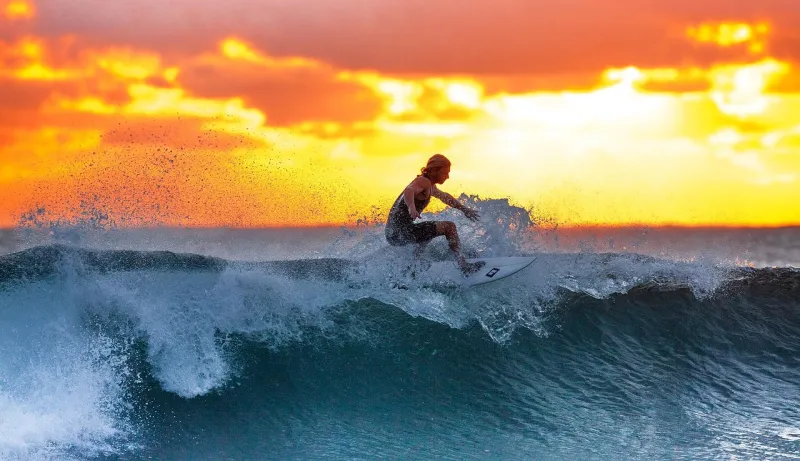
Asphalt Lineups: How Skate Parks and Pump Tracks Are Keeping Surf Culture Alive Inland
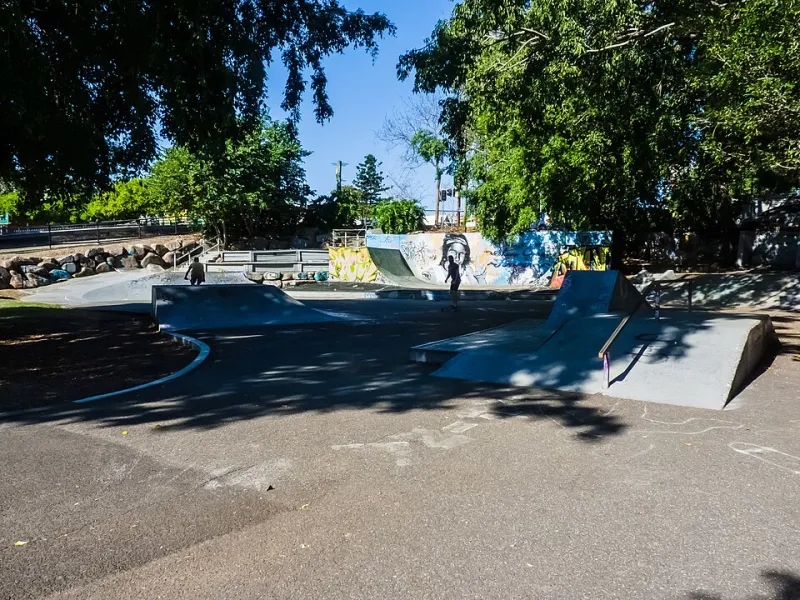
Photo: John Robert McPherson, CC0, via Wikimedia Commons
On a Tuesday evening in Columbus, Ohio, a group of about fifteen people has gathered at a concrete park tucked behind a strip of industrial warehouses. There are skateboards, of course, but look closer and you'll notice the way several riders are pumping through the transitions — generating speed without pushing, carving rail-to-rail through the bowl's hips with a fluidity that looks less like street skating and a lot more like surfing. A few of them have surfboards in the beds of their trucks. The nearest ocean is about seven hundred miles away.
"This is our beach," says Jordan Reyes, 28, who grew up surfing summers in New Jersey before moving to Columbus for work. "I couldn't give up the feeling. So I found the next closest thing."
What Jordan found — and what thousands of surfers across the landlocked interior of the United States are discovering — is that concrete, when shaped right and ridden with the right intent, can deliver something surprisingly close to the sensation that keeps surfers coming back to the water. More than just a training workaround, DIY skate parks and pump tracks are becoming genuine hubs of surf culture in places that have never seen a wave.
The Rise of the Concrete Crew
The connection between surfing and skating is older than most people realize — it was California surfers in the 1950s and '60s who first grabbed roller skate wheels and bolted them to wooden planks, looking for a way to practice when the surf was flat. That lineage never really disappeared, but it's experiencing a genuine renaissance right now, fueled by the wave pool boom, the mainstreaming of surf culture through social media, and a generation of people who discovered surfing on YouTube and Instagram before they ever touched the ocean.
Across the country, surf-minded communities are coalescing around skate infrastructure in unexpected places. In Denver, a crew calling themselves the Mountain Lineups has built a dedicated following around the city's network of pump tracks and concrete parks, hosting informal "surf skate" sessions where the goal is explicitly to practice ocean-applicable movement patterns. In Austin, a group of transplants from California and Florida has turned a local skate park into a weekly meetup that functions more like a surf club than a skate session — complete with wave condition check-ins from back home and heated debates about fin setups.
"The culture traveled with the people," says Marisol Gaines, who moved from Encinitas to Nashville three years ago and immediately started looking for ways to maintain her connection to surfing. "You'd be surprised how many surfers are out here. You just have to find them."
Building It Themselves
Not everyone is waiting for city planners to build the infrastructure they need. The DIY concrete movement — surfers and skaters pooling resources and labor to build their own spots — has been a part of action sports culture for decades, but it's finding new energy from the surf community's involvement.
In rural Vermont, a collective of about twenty surfers and skaters spent two summers pouring a backyard bowl on a property outside Burlington. The project was inspired by its organizer, a former competitive surfer named Derek Sato who relocated from Southern California and refused to let his skills atrophy through long New England winters.
"I drew the plans based on my favorite wave shape," Sato says. "The entry is like a point break — long, gradual, lets you set your line. The bowl section is more like a beach break, punchy and fast. I wanted it to feel like surfing when you rode it."
Sato's spot has become an unofficial community center for Vermont's surprisingly active surf scene. Riders drive hours to session it. People camp out on weekends. There's a fire pit, a gear swap, and a whole social ecosystem that has grown up around a concrete structure that technically doesn't exist on any official map.
This kind of grassroots infrastructure building mirrors something that's been happening at the organized level too. Pump track builders like World of Bikes in Iowa City and various YMCA-affiliated programs have begun explicitly marketing their facilities to surfers as off-season training tools — a recognition that the market for surf-adjacent experience extends well beyond the coasts.
A New Entry Point for the Sport
One of the most significant effects of this inland concrete culture is something that doesn't get discussed enough: it's creating a pipeline into surfing for people who would never have found it otherwise.
For a kid growing up in Kansas City or Memphis or Minneapolis, the ocean is an abstraction — a vacation destination, if that. But a skate park or pump track is right there, accessible and free, and if the local crew happens to be deeply surf-influenced, the culture travels with the sessions.
"I learned everything I know about surfing from people I met at the skate park," says Tyler Moss, 22, who grew up in suburban St. Louis and took his first real surf trip to the Outer Banks last summer after years of skate sessions with a crew that obsessively studied surf videos and replicated the movements on concrete. "When I finally got in the water, my coach said I already moved like a surfer. I'd never even been on a surfboard before."
That transfer of movement knowledge — from concrete to water — is something coaches and instructors are starting to take seriously. Several surf schools on both coasts have begun incorporating pump track and skate sessions into their curricula, especially for adult learners who struggle to develop balance and body mechanics in the unpredictable ocean environment.
The Stoke Doesn't Need an Address
What strikes you most, spending time with these inland communities, is how fully they've embraced the emotional core of surf culture — not just the tricks or the gear, but the particular kind of joy that comes from riding something with your whole body, from feeling momentum and gravity work together, from the camaraderie of a crew that shows up consistently for no reason other than the shared love of the feeling.
Reyes, back in Columbus, wraps up his bowl session as the sun drops behind the warehouse buildings. He's dripping sweat, grinning wide, already talking about a trip to the Gulf planned for next month.
"People ask me if I miss surfing when I'm here," he says, tucking his board under his arm. "But this is surfing. Just without the water."
Hard to argue with that.