Don't Say the Q-Word: The Rituals, Omens, and Strange Magic of American Surf Culture
Let's get one thing straight before we go any further: you do not say the word quiet at a surf spot. Not "it looks quiet out there." Not "it's been a quiet morning." Not even in an unrelated context. You just don't. If you do, whatever waves were coming will evaporate immediately, the swell will back off, and the wind will clock onshore, and it will be entirely your fault. Everyone at the break will know it.
This is not a fringe belief. Ask around at any established surf community — from the point breaks of Malibu to the beach breaks of New Jersey to the reef passes of Hawaii — and you'll find some version of this rule. The specific forbidden word might vary by region. The consequences are always the same: flat, hopeless, embarrassing nothing.
Surfers are, on paper, a pretty pragmatic bunch. They read meteorological data, study tide charts, track swell models across multiple apps. And yet — and this is the beautiful contradiction at the heart of surf culture — most of them also have a ritual they will not skip, a piece of gear they will not replace, or a phrase they will not utter before paddling out. The magical thinking runs deep, and it's worth celebrating.
The Lucky Gear Phenomenon
Every serious surfer has a piece of equipment that has transcended its functional purpose and become something more like a talisman. For some, it's a wetsuit — specifically, a wetsuit that should have been retired two seasons ago but has been present for too many good sessions to abandon. The zipper sticks. The knee panels are thin enough to read through. Doesn't matter. That suit goes in the bag.
For others, it's a leash — a particular color, a particular brand, a particular length that they associate with the day they got the best barrel of their life. Replacing it feels less like an upgrade and more like a betrayal. There are surfers on the East Coast who've had the same fin key on their keychain for a decade, not because they're sentimental people in general, but because that fin key has never let them down.
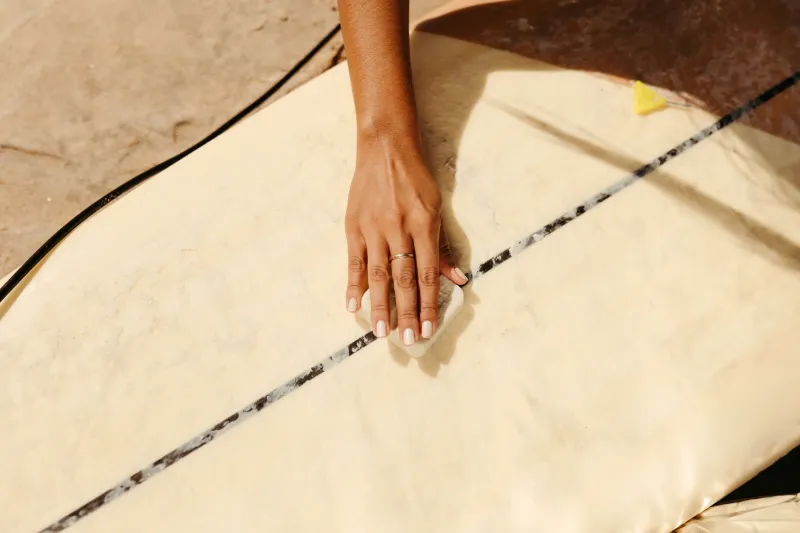
Wax is its own category entirely. The ritual of waxing a board before a session is one of the more meditative acts in surfing — repetitive, tactile, slightly hypnotic. Some surfers have a specific pattern they follow. Some have a base coat brand they won't deviate from. Some apply wax only in a particular direction, counterclockwise or in long diagonal strokes, because that's how they did it the first time they surfed somewhere really good and they are not interested in experimenting.
Pre-Session Playlists and the Power of the Drive
The drive to the beach is a ritual unto itself, and in the age of streaming, the playlist has become one of its most fiercely guarded elements. Talk to surfers about their pre-session music and you'll hear a level of specificity that borders on liturgical. Not just a genre — a specific song, in a specific position in the queue, that has to play before they park the car.
Skip it accidentally and the session is already compromised. Let someone else control the aux cord and you're surfing into uncertainty. One surfer in the Pacific Northwest described refusing to get out of his truck until the last thirty seconds of a particular song finished playing, even after his friends had already grabbed their boards and were walking toward the water. "I just knew," he said, without elaborating further.
This isn't unique to any one region or demographic. Competitive surfers do it. Weekend warriors do it. The sixty-year-old who's been surfing the same break since the Carter administration does it, except his ritual involves a specific AM radio station that plays classic rock at exactly the right volume. The medium changes. The behavior doesn't.
What You Don't Say (And What You Never Do)
The forbidden phrases extend well beyond the Q-word. "It looks like it's getting better" is considered by many to be a jinx of the highest order, guaranteed to trigger an immediate deterioration in conditions. Some surfers won't compliment the waves out loud while they're surfing them — a superstition borrowed loosely from theater, where you don't tell someone they're doing well mid-performance.
Then there are the behavioral taboos. Don't turn around and look back at the beach once you've committed to paddling out — bad luck, lost focus, or both depending on who you ask. Don't count your waves mid-session. Don't tell someone else how many good ones you've caught. And absolutely, under no circumstances, do you predict what the afternoon is going to look like. The ocean will hear you. It will disagree.
There's also a widely observed practice around gear failures. If your leash breaks before a session, many surfers take it as a sign — not necessarily a bad one, but a signal that the session is going to be unusual in some way. Whether that means getting out of the water or simply paddling out with extra awareness varies by individual.
Where Ritual Meets Community
What's genuinely touching about surf superstitions is how communal they become. Within any established local crew, the rituals get shared, borrowed, and eventually codified into group practice. One person's lucky routine becomes the crew's pre-session tradition. The thing that started as private magical thinking becomes a bonding mechanism — a shared language that reinforces belonging.
A group of dawn patrol regulars in Southern California has a standing rule that no one discusses work, news, or anything happening on land until they're back in the parking lot with coffee in hand. That started as one person's way of protecting the mental space around surfing. Now it's just how the crew operates. Nobody remembers who started it. Nobody questions it.
That's the real function of superstition in surf culture — not to control the ocean, which everyone rationally understands is impossible, but to create a container for the experience. A ritual says: this time is different from the rest of the day. This matters. Pay attention. In a culture built around chasing something as unpredictable as waves, that kind of intentionality isn't irrational at all.
It's actually pretty wise. Just don't say it's quiet out there.