Still Charging: The Surfers Who Refuse to Let Age Write Their Story
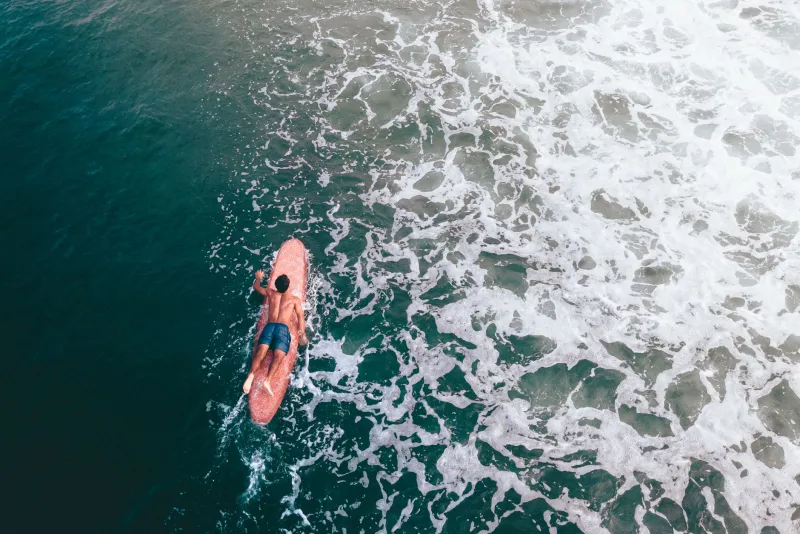
Somewhere between the young guns on their performance shortboards and the tourists trying to stand up for the first time, there's a surfer you might not immediately notice. They paddle out without fanfare. They sit a little wider in the lineup, reading the horizon with the calm of someone who's seen a thousand swells come and go. When a set arrives, they're already in position — not because they're faster, but because they've been watching long enough to know where to be.
This surfer is in their 50s, maybe their 60s. They've been doing this for thirty years. And they are, in ways that don't always show up in highlight reels or Instagram feeds, some of the most accomplished people in the water.
The Body Learns to Negotiate
Anyone who's been surfing for decades will tell you the same thing: the body changes, and you either adapt or you quit. The surfers who stay in the game long-term are almost universally people who've made peace with that negotiation — and who've gotten creative about how they maintain their relationship with the water.
For many, that means a serious shift in physical preparation. Yoga, which would have seemed laughably unrelated to surfing to most wave riders twenty years ago, has become a cornerstone practice for older surfers managing flexibility and joint health. Strength training, swimming, Pilates — the off-the-water work that younger surfers often skip becomes the foundation that makes continued surfing possible.
Robert, 57, has been surfing the breaks around the Outer Banks since the late 1980s. He had shoulder surgery at 51 and spent eighteen months wondering if he was done. "I came back differently," he says. "I do more yoga now than I ever thought I would. I warm up before I paddle out. I used to think that was for people who couldn't surf. Now I think it's for people who want to keep surfing."
That shift in mindset — from invincibility to intentionality — shows up consistently among surfers who've navigated the physical challenges of aging without walking away from the water.
Equipment as Adaptation
One of the most visible ways older surfers stay in the game is through intelligent equipment choices, and this is where the surf industry has quietly caught up with a market it ignored for too long. The explosion of mid-length boards, modern longboards, and high-volume shapes over the past decade has been a gift to experienced surfers whose bodies can no longer sustain the low-volume, high-performance boards that dominated the 1990s and 2000s.
The calculus is simple: more volume means easier paddling, earlier wave entry, and less energy spent fighting to get into position. For a surfer in their 50s with a day job, family obligations, and two sessions a week to work with, efficiency isn't a compromise — it's strategy.
"I rode a 6'2" thruster for most of my thirties," says Diane, 61, who surfs regularly in Santa Cruz. "Now I ride a 7'8" mid-length and I catch more waves than I ever did on the shortboard. Better waves, too. I'm not fighting for position anymore. I'm just surfing."
This kind of equipment wisdom — knowing what actually serves your surfing rather than what looks right in the parking lot — is something that takes years to develop. It's one of the quiet advantages of experience.
Reading the Water
Here's what doesn't decline with age, at least not at the same rate as physical capacity: ocean knowledge. The ability to read a break, anticipate how a swell is going to behave, identify the best position in a shifting lineup — these are skills built through repetition over years and decades, and they compound in ways that raw athleticism simply cannot.
An experienced surfer in their 50s might not generate the same explosive power off the bottom turn they had at 25. But they're also not burning energy paddling for waves that aren't going to work, or sitting in the wrong spot when the set swings wide. They've seen enough to know what's coming before it arrives.
This is the skill that younger surfers — even talented ones — often underestimate when they're sharing a lineup with older regulars. Getting caught inside by a set that the grizzled 58-year-old somehow avoided is a humbling experience that teaches more than any lesson could.
Unexpected Mentors
What's become increasingly clear in American surf communities is that older surfers occupy a cultural role that goes beyond just riding waves. They're the keepers of local knowledge — the people who remember what a break looked like before the jetty was modified, who know which sandbar produces the best waves at which tide, who can tell you what the wind is going to do based on how the morning felt when they drove in.
And increasingly, they're mentors in ways that are both formal and informal. Some of the most effective surf instruction happening in American lineups right now isn't coming from certified coaches — it's coming from the 55-year-old who's been surfing the same beach for twenty-five years and has a patient eye for what a newer surfer is doing wrong.
That transfer of knowledge — casual, unstructured, offered in the water between sets — is one of the mechanisms through which surf culture actually perpetuates itself. It doesn't happen on YouTube. It happens when someone who's been around long enough to know something decides to share it.
What Staying In It Actually Means
The surfers who keep going into their 50s, 60s, and beyond aren't doing it to prove something to anyone. They'll tell you that pretty directly if you ask. They're doing it because the water is still the place where something important happens — something that's hard to name but impossible to replace.
For some, it's the meditative quality of it, the way an hour in the ocean reorganizes the noise of a week. For others, it's the community — the people they've known for decades who still show up at the same break, the shorthand that develops between people who've surfed together through life changes and losses and good seasons and bad ones.
And for some, honestly, it's the waves themselves. The same thing that pulled them in at 19 is still pulling at 59. The ocean didn't change. The stoke didn't go anywhere. The body adapted. The boards changed. The approach evolved.
But they're still out there. Still reading the horizon. Still in position when the set comes.
That's not a small thing. That's a life.