What Your Quiver Says Behind Your Back
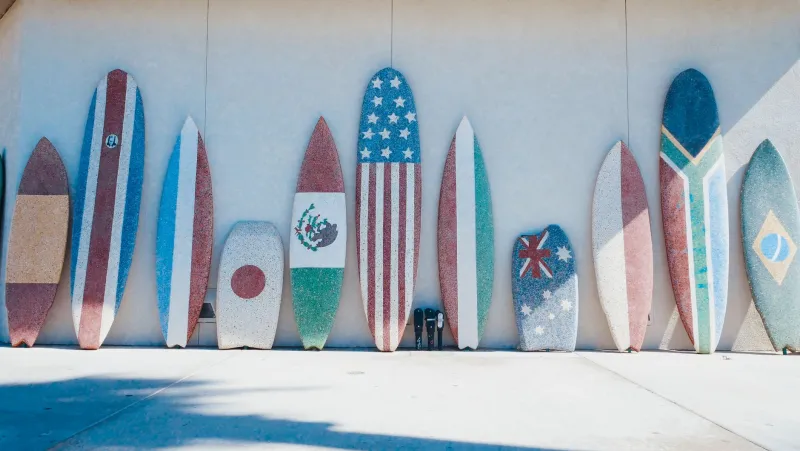
Walk into any surf shop along the California coast, the Outer Banks, or the Gulf's forgotten breaks, and you'll notice something. The boards on the wall aren't just products. They're personality types. They're ambitions. They're confessions. Most surfers will tell you they choose a board based on conditions, wave height, or how their back is feeling that morning. But spend enough time in any local scene and you start to realize: the boards we ride are less about the ocean and more about who we think we are — or who we're trying to become.
The Soft-Top and the Stories We Tell Ourselves
Every quiver starts somewhere, and for a growing number of American surfers, that somewhere is a foam soft-top. A few years ago, riding a foamie past your first summer was considered a mild embarrassment. Now? It's practically a philosophical statement. The soft-top renaissance has scrambled the old hierarchy in a genuinely interesting way.
Beginners cling to them for obvious reasons — forgiveness, buoyancy, and the small mercy of not getting knocked unconscious by your own board. But increasingly, experienced surfers are pulling foam boards out on overhead days, ripping turns that have no business happening on something that looks like a pool toy. What's the message? Roughly: I'm good enough that it doesn't matter what I'm riding. The soft-top, once a symbol of inexperience, has become a flex in disguise.
For true beginners, though, the soft-top carries a different kind of weight. It's the board that says, I'm new here, and I know it. In most healthy surf communities, that honesty gets respect. Show up on a foamie, stay in the whitewash, and work your way toward the shoulder — you're playing the game correctly. The boards we choose in those early months telegraph our self-awareness as much as our skill level.
The Longboarder's Quiet Confidence
There's a particular type of surfer you'll find at almost every point break in America: the longboarder who's been riding the same break for fifteen years and has absolutely nothing to prove. Their board is usually over nine feet, often has a single fin, and sometimes looks like it was shaped during a different presidential administration. It probably was.
Longboarding carries its own internal culture, one that prizes style over power, flow over aggression. The surfer who commits to the log is making a statement about values — patience, aesthetics, the idea that surfing is less a sport than a conversation with the water. In a lineup dominated by performance shortboards, the longboarder often occupies an almost elder-statesman role, whether they want it or not.
But here's the thing about quivers: most serious longboarders don't only ride logs. Peek in their van and you'll find a mid-length, maybe a fish, possibly a beat-to-death shortboard they pull out when the swell gets serious. The variety reveals something — a surfer who's curious, adaptable, and secure enough in their identity not to need one board to define them.
The Performance Shortboard and the Weight of Expectation
Nothing announces ambition quite like a 6'0" high-performance shortboard in the hands of someone who's still figuring out how to generate speed. It happens at every beach in America, and it's not really something to mock — it's something to understand. Buying the board you aspire to ride is a time-honored tradition, a way of committing to a version of yourself that doesn't quite exist yet.
Among competitive surfers and those who orbit contest culture, the shortboard quiver gets specific in a hurry. A board for small, punchy beach break. A step-up for when the swell hits overhead. A dedicated gun for the rare XXL day most of us will never actually surf. Each board in the collection represents a scenario the surfer has imagined themselves in — and that imagination is genuinely revealing.
The surfer with a full performance quiver is someone who thinks about surfing constantly, who reads forecasts the way other people read the news, who has opinions about rocker lines and concave depths that could fill a dinner conversation. Their boards are a map of their obsession.
Mid-Lengths, Hybrids, and the Surfer Who's Made Peace
Perhaps the most telling board in any modern quiver is the mid-length — that 7'0" to 8'6" range that lives between the worlds of longboarding and shortboarding and belongs fully to neither. Surfers who gravitate toward mid-lengths tend to be people who've been through the performance wars and come out the other side with a clearer sense of what actually makes them happy in the water.
They've usually tried the shortboard route, found it frustrating on mediocre days (which is most days, let's be honest), and landed on something that catches waves easily, turns with enough response to stay interesting, and doesn't require perfect conditions to be fun. The mid-length surfer has often stopped caring what the lineup thinks of their equipment — a genuinely liberating place to arrive.
Hybrid shapes — the fish, the egg, the stubby little things that look like someone sat on a shortboard — occupy similar psychological territory. They're boards for surfers who've decided that fun is the whole point, and who are comfortable enough in their identity not to need their equipment to signal anything in particular.
The Quiver as Community
Here's what's worth sitting with: in most American surf communities, your board collection is a conversation starter, not a credential check. The surfer who shows up with one beat-up longboard and rides it joyfully every session for ten years earns a different kind of respect than the one who rotates through a new quiver every season chasing the latest shape trends. Consistency tells its own story.
And the surfer who's always got something unusual — a paipo board, a bellyboard, a hand-planed wooden finless thing they shaped in their garage — is almost always someone worth talking to. Weird boards attract interesting people, or maybe interesting people are just drawn to weird boards.
At the end of the day, the boards we ride are less about impressing the lineup and more about the ongoing negotiation we have with ourselves about what surfing means to us. That negotiation never really ends. Which is, honestly, most of the fun.